Dirección
304 North Cardinal
Dorchester Center, MA 02124
Horas de trabajo
De lunes a viernes: de 7.00 a 19.00 horas
Fin de semana: 10.00 A 17.00 HORAS
Dirección
304 North Cardinal
Dorchester Center, MA 02124
Horas de trabajo
De lunes a viernes: de 7.00 a 19.00 horas
Fin de semana: 10.00 A 17.00 HORAS
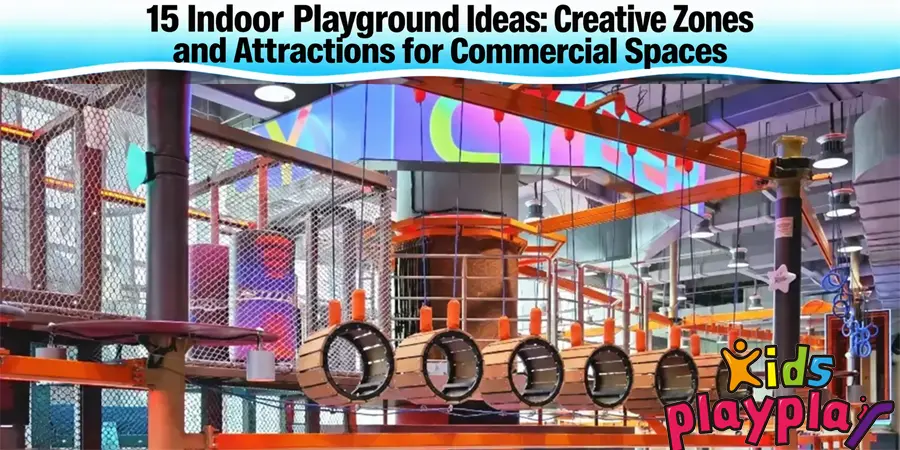
The best indoor playground ideas fit your target users, building conditions, business model and budget. You might choose a multi-level soft play structure, toddler zone, ball pit, ninja course, interactive games or themed adventure area…
This guide compares 15 practical ideas for commercial play centers, malls, schools, daycares, restaurants, hotels and community venues,helping you decide which attractions fit your building and project goals.
15 Indoor Playground Ideas: compare soft play and ball pits, ninja courses, climbing, sensory play, interactive games and themed areas.
Venue type ideas: adapt the ideas for play cafes, FECs, malls, schools, hotels and community centres.
Space and Age Sizing: Adapt rides for space, ceiling height and age group.
Functional Layout Design: Design for zoning, traffic flow, line formation, cleaning, and access for installation.
Safety, Materials and Cost: Consider these factors prior to final design and manufacturing.
Custom Project Preparation: Learn what site information is required for a feasible equipment quote.
A multi-level soft play structure connects platforms, tunnels, bridges, climbing obstacles and slides while using vertical space efficiently. Ball games, play panels or quieter activities can sit below raised platforms.
Strong layouts offer more than one route, so a busy bridge or slide does not stop the whole flow. In project layouts that Kidsplayplay review, the concept often changes once ceiling beams, columns, exits and service clearances are mapped. Design around these fixed conditions rather than squeezing a standard unit into the room.

A ball pit and slide zone can connect straight, wave, spiral or tube slides with soft climbing steps, obstacles and interactive ball games.
Slide height is only one design decision. The exit direction, landing space, ball containment and nearby traffic also affect how the zone operates. Provide controlled entrances and practical cleaning access. For a mixed age group, offer varying levels of challenges or separate play zones instead of forcing all children into one overcrowded ball pit.
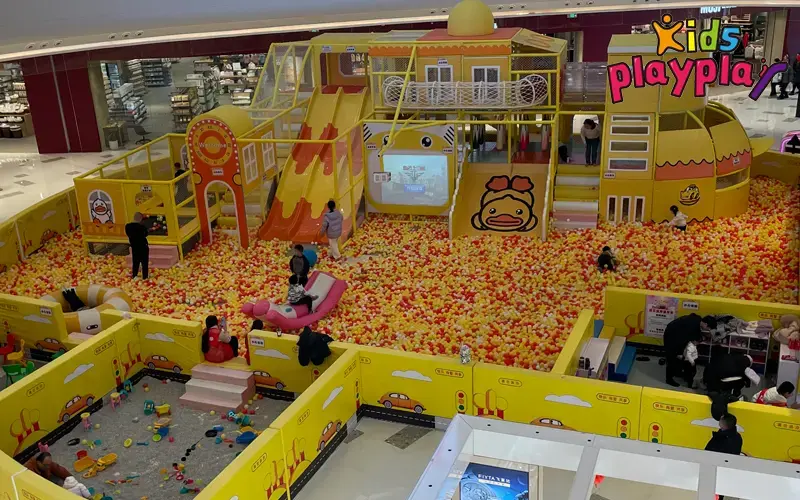
A toddler area provides a gentler place for younger children to crawl, climb and explore away from faster play. Small slides, low platforms, soft shapes, tunnels, blocks and sensory panels are some of the appropriate features.
Place the entrance within easy reach of caregivers and use a low boundary without blocking sightlines. A recurring layout problem is treating toddler play as leftover space. Give it a clear route, suitable activity density and room for caregivers. Choose age-appropriate play instead of shrinking older children’s equipment.
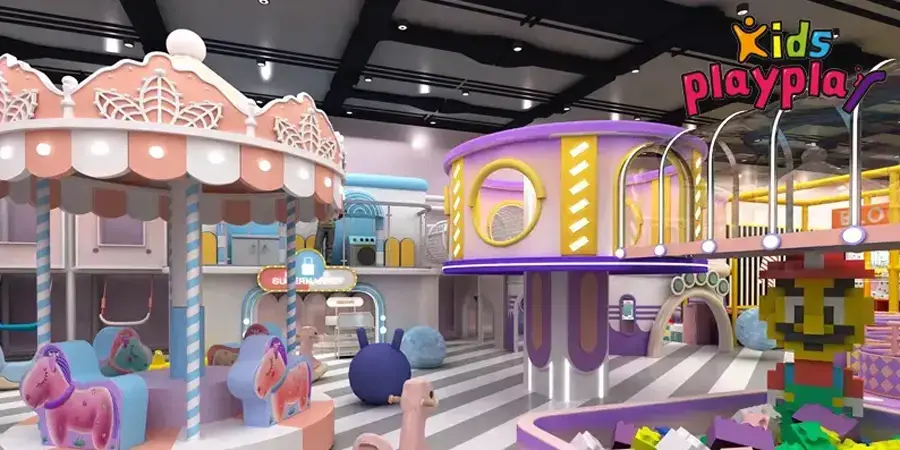
A soft obstacle course may include foam ramps, rollers, wedges and balance paths, crawl-through shapes and low climbing challenges, without the need for a tall structure. It works well for preschool venues and buildings with low ceiling heights.
The fixed obstacles provide a clear route and the modular pieces allow the staff to refresh the activity. Decide before production as anchoring, storage and daily set-up can vary. Keep challenging elements clear of entrances and main walkways.

A ninja course with hanging obstacles, floating steps, balance elements and climbing features offers repeatable challenges for older children. There are various levels of difficulty and detours, so beginners may participate without hindering confident users.
Don’t judge the course by the number of obstacles. Ceiling height, fall areas, queue space, supervision and throughput all count. A shorter course with a defined start, stop and reset can be more effective than a dense course that creates waits or staff blind spots.

School-age children, teenagers and groups can add high-energy play in the trampoline zone. It may include connected jump areas, basketball, dodgeball or simple skill games.
Keep it separate from toddler and low energy play, with controlled access, capacity and circulation. Check the floor’s condition, the protective zones and the staffing ratios before you sign off on the setup. By mixing trampoline park attractions with soft play, families should be able to get to each zone without crossing active routes.

Indoor climbing wall is a physical challenge on vertical surfaces. You can offer low horizontal routes for younger children or more difficult routes for older users, as appropriate.
Offer a few challenge levels but only confirm the wall type after checking the supporting structure, anchor positions, fall area, supervision and installation access. These details influence the equipment design and the site work. Climbing walls are a natural fit for adventure centers, schools and family entertainment venues.

Children can cross bridges, climb between levels and pick from several routes through an open structure using a suspended rope net maze, without the need for solid platforms.
The design needs reliable site dimensions and confirmed connection conditions before fabrication. Provide access for routine inspection and component replacement, not just for installation. Also check how children enter and leave and return to floor level; a visually impressive maze can still underperform if one narrow exit creates a bottleneck.

Interactive projections can turn a wall or floor into a play space for movement-based games. Children may touch targets, follow moving images, play virtual ball games or collaborate on simple challenges. This can refresh content without rebuilding the main structure and can work in a low ceiling space.
Confirm clear play area, ambient light, power and data points, equipment location and update method. Do not block service access to the projector, sensors or control unit. And remember use digital interaction as a layer of the experience, not the whole playground.

Electric interactive soft play consists of padded equipment which has gentle movement, lights, sound or touch responses. Rotating soft features, musical equipment, and cause-and-effect activities can bring variety to a toddler or family play area.
Choose functions suitable for the age and application of the target. Solve power routing, emergency controls, inspection points and replaceable components within the layout. Service points should be easily accessible to staff and out of reach for children.

A pretend city includes familiar locations such as a supermarket, kitchen, clinic, fire station, construction site or small street. Playhouses, counters, signs, props and interactive panels enable children to create stories and play together.
This idea works for preschool venues, early-learning centers and play cafés. Open layout supervision. Store loose props and make sure high-touch surfaces are easily cleanable or replaceable. Seasonal details can rejuvenate the space without having to redevelop it.

Tactile panels, sound activities, gentle lighting, ground-level play, accessible routes and a quieter retreat can all be brought together in a sensory and inclusive zone. The idea is to make it possible to participate in many ways, not to isolate every inclusive feature in a corner.
Spread accessible and sensory activities around the playground wherever possible. Provide active and low-stimulus options, with space for caregivers, seating and clear circulation. Tailor your final combination to the community you serve.
A STEM area can use magnetic building pieces, gears, pipes, tracks, mechanical panels or large construction blocks. Kids can build, test and troubleshoot while taking a break from high-energy play.
Wall activities save floor space and larger stations can accommodate group projects. Loose pieces Plan size, Storage, Inventory and cleaning Individual activities can be renewed without any change to the whole zone thanks to replaceable wall panels.
Tree-like towers, animal features, rope bridges, climbing nets, caves and slides can be used to build an indoor exploration route in a jungle zone. Movement should be guided by theme: children could climb a tree tower, cross a bridge, crawl through a cave and end with a slide.
Custom shapes and panels create identity but also impact production, packing and installation. We tend to keep the play route and structural modules clean and then target more detailed theming at entrances, centers and areas for interaction at child height. Makes a great story without spending the entire budget on decoration.
A space playground can feature a rocket tower, clear tunnel, planet panels and interactive lights. An ocean concept could include a ship, a submarine, coral shapes, sea creatures and wave shaped slides.
Focus on a series of activities, not just decoration. Before production, check large custom features against freight dimensions, building doors and the installation sequence. Check out more styles of commercial indoor playground equipment before deciding on a theme for your audience, brand and site.
If you want to learn more about creative themes, you can check out kidsplayplay’s indoor play equipment or consult with us to customize your own exclusive themed playground.
Your venue determines how to choose an attractive combination of indoor play equipment. For example, a play café needs visibility and parental comfort; a family entertainment center requires a broader age range and stronger core appeal.
| Venue | Ideas to Consider | Planning Focus |
| Play café | Toddler soft play, pretend city, sensory panels, compact ball pit | Clear sightlines, quiet seating and easy cleaning |
| Family entertainment center | Multi-level soft play, ninja, trampoline, climbing, rope maze | Age coverage, throughput and repeat visits |
| Mall or retail venue | Themed soft play, interactive projection, toddler zone | Controlled entry, visual impact and compact circulation |
| Daycare or school | Soft obstacles, sensory play, STEM wall, role play | Age-appropriate challenge and supervision |
| Hotel or resort | Jungle or ocean theme, toddler play, compact climbing | Guest experience, durability and fit with the interior |
| Community center | Modular soft play, inclusive activities, climbing | Flexible use, accessibility and varied abilities |
Choose a combination of ideas that can match your daily operations. Because adding each device may further increase costs and complexity without improving your users’ play experience.
Match each indoor playground idea to usable space and target ages. Define your users and play intensity and then verify that the floor area, clear height and fixed features will support them.
| Space Condition | Typical Age Focus | Indoor Playground Ideas to Consider |
| Small or low-ceiling space | Toddlers and preschoolers | Low soft play, small slides, sensory panels, pretend play and activity walls |
| Medium space | Toddlers to younger school-age children | Multi-level soft play, ball pits, slides, role play and interactive games |
| Large or high-ceiling space | Mixed ages or older children | Multi-zone soft play, ninja courses, trampolines, climbing walls and rope net mazes |
| Irregular space with columns | Varies by target users | Custom modular structures, wall games, compact role play and features built around fixed elements |
These are starting points, not rules cast in stone. Separate toddlers from faster or higher-challenge play in mixed-age venues, while maintaining clear circulation and sightlines. Before you draw up the equipment plan, check the beams, columns, exits and service points.
Turn indoor playground ideas into a practical layout by moving from site facts to play zones, user flow and buildable equipment. Each attraction should have a clear purpose and a feasible site. For more general guidance on zoning and ideas for play variety, see these playground design ideas.
Map existing space. Work from a dimensioned floor plan—not total area alone. Clearly mark height, beams, columns, doors, exits, fixed services and access for installation. Provide for reception, seating, party rooms and storage in the non-play space.
Define Users and Capacity. Validate target ages, peak capacity and visitation patterns. In mixed age venues determine which groups need separate zones. These choices impact challenge levels, equipment size, route numbers and queues.
Pick the anchor attractions. Pick one or two features that define the venue such as multi-level soft play, a ninja course or themed tower. Offer creative, sensory and social activities, not repeat one play experience.
Building Zones Around Daily Operation. Toddler play is available to caregivers . High energy activities are located away from quiet zones and staff routes . Link seating, party rooms and waiting areas without breaking circulation.
Check sight lines and circulation. Trace entry to queue, play and exit for children, caregivers and staff. Look for crossings, bottlenecks, dead ends, slide exits, return routes. In project reviews another attraction often provides a better flow than a second route.
Check for buildability and local requirements. Verify structural connections, protected zones, electricity, data, service access and large component entry to the building. Finalize the equipment specifications and production, and check local requirements.
Review this checklist prior to production and installation. It brings together safety, materials, budget and project information so the design can be built as designed.
Check barriers, gaps, fall areas, surfaces and supervision. The age separation and activity routing is already done in the layout steps above.
Equipment, Building, Fire, Electrical and Accessibility requirements vary from project to project. Before going to production and installation, confirm them locally.
Ask about the plans for the frame, platforms, padding, nets, plastic parts and hardware.
See how to inspect, clean and replace high-use parts.
Design, equipment, freight, installation, flooring, interior work, utilities, approvals and spare parts budget.
When comparing proposals, don’t just compare the price. Make sure that the scope includes the same zones, materials, accessories, installation information and after sales items. Do not assume quotations with different scope are equivalent.
Defend the main play path and customize the most visible spots on a budget.
The most useful project brief we get has a dimensioned plan, clear height, photos or video, target ages, preferred attractions, theme, destination country and budget. This enables the equipment to travel with the building and changes can still be easily made.
Photos or video can show conditions not shown on a drawing.
Do not confirm production until site dimensions and local requirements are known.
KidsPlayPlay can designs and manufactures indoor playground equipment for different commercial spaces, themes and play requirements. You can follow the actual building with your plan. Production and installation information is then prepared for the confirmed design. If you have a possible site please contact us to discuss the appropriate concept.
You can fit in compact soft play, toddler equipment, pretend play, wall activities and interactive projections. Choose multi-functional features Make use of any vertical space available Maintain circulation
Toddlers may enjoy low soft play and sensory activities, preschool children can use slides, tunnels, ball pits and role play. Older children require harder climbing, ninja, trampoline or rope activities. Zones with different speed and difficulty levels.
Typically one dominant theme provides a linked space with a variety of activity areas. If you have multiple themes, tie them all together with one larger story, color system or journey.
Send an accurate floor plan, clear ceiling height, columns, entrances, fixed services, target ages, preferred attractions, destination country and budget if available. Photos or video can help explain the beams, windows, utilities and access conditions that may not be evident on the drawing.
Appropriate indoor playground ideas can provide children with meaningful ways to move, imagine, explore, and play together. Choose specific indoor playground ideas based on your users and venue, then evaluate the conditions for construction, operation, production, and installation. Kidsplayplay is happy to provide you with full guidance and assistance.

Scan to add WeChat